
Why OAuth, SAML, and SCIM Won't Survive the Agentic AI Era
The Identity Crisis Nobody Is Talking About
The modern enterprise identity stack was built for humans.
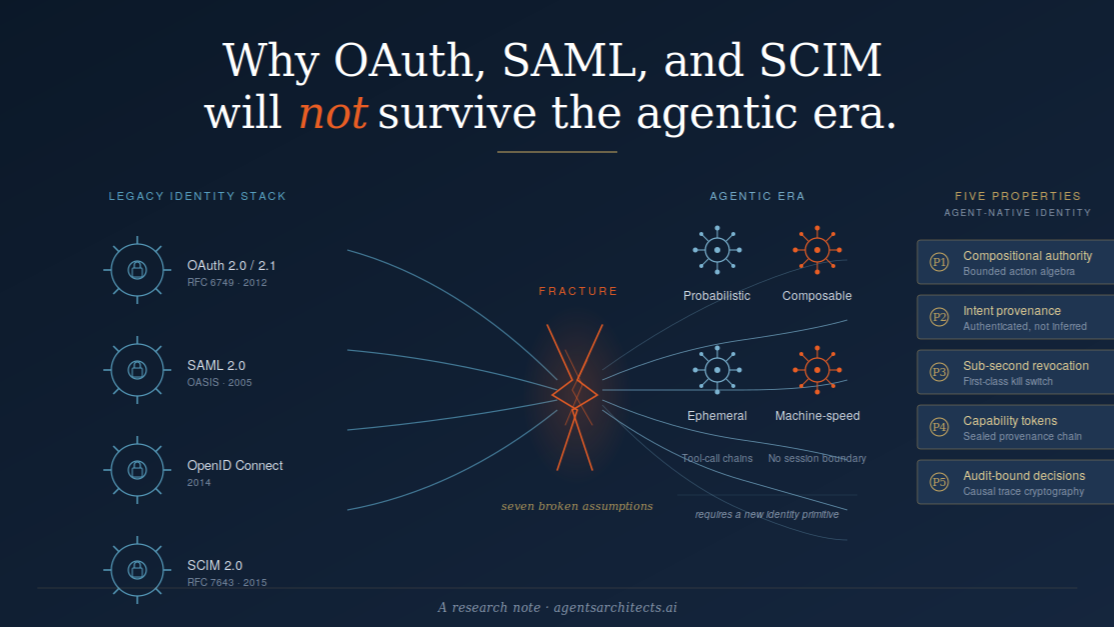
Protocols such as OAuth 2.0, OAuth 2.1, OpenID Connect (OIDC), SAML 2.0, and SCIM were designed between 2005 and 2020 around a common assumption: a human user logs in, grants consent, performs actions, and eventually logs out.
That model has served enterprises well for nearly two decades.
However, the rise of autonomous AI agents is exposing fundamental limitations in these protocols.
AI agents do not behave like human users. They operate at machine speed, make decisions based on probabilistic reasoning, chain together multiple tools and services, and often execute tasks without clear session boundaries.
As organizations deploy increasingly autonomous AI systems, the identity foundations that power today's enterprise infrastructure are beginning to show their age.
The challenge is not configuration.
The challenge is architecture.
Why Existing Identity Protocols Are Struggling
Traditional identity systems were designed around predictable actors.
An employee logs into a system.
A service account performs a predefined task.
An administrator grants permissions and periodically reviews access.
AI agents introduce an entirely different operating model.
Unlike service accounts, agents:
- Interpret natural-language instructions
- Make decisions at runtime
- Interact with multiple applications simultaneously
- Execute actions across different resource servers
- Continuously adapt their behavior based on context
The same OAuth token that once authorized a deterministic workflow may now authorize a highly dynamic sequence of actions.
This creates new security and governance challenges that existing identity frameworks were never designed to solve.
Seven Assumptions That Break in the Agentic Era
1. Stable Identity Assumption
Traditional protocols assume that an identity represents a stable human or service principal.
An AI agent is neither.
Its behavior evolves based on prompts, retrieved data, tool outputs, and environmental context.
The identity remains the same, but the behavior can change dramatically from one interaction to the next.
2. Consent Is Predictable
OAuth assumes users understand and approve a defined set of actions.
Agents complicate this model.
A user may approve access to email, calendars, and CRM systems individually.
However, an agent can combine those permissions to perform actions that were never explicitly anticipated.
The resulting behavior emerges from permission composition rather than a single permission grant.
3. Sessions Have Clear Boundaries
Traditional authentication assumes:
- Login
- Active session
- Logout
Agentic workflows rarely follow this pattern.
An AI agent may operate continuously for hours or days while spawning sub-agents, calling external tools, and coordinating complex workflows.
The concept of a traditional session becomes increasingly meaningless.
4. Intent Can Be Verified
Most authorization systems assume user intent can be validated through:
- Consent screens
- MFA challenges
- Step-up authentication
AI agents challenge this assumption.
An agent's behavior may be influenced by:
- User instructions
- Retrieved documents
- External APIs
- Other agents
- Prompt injection attacks
Determining the true source of intent becomes significantly more difficult.
5. Revocation Is Fast Enough
Traditional identity systems tolerate delays between detecting a compromise and fully revoking access.
For human users, this is often acceptable.
For AI agents operating at machine speed, even a few minutes can be catastrophic.
An autonomous agent can perform thousands of actions before a revocation event propagates across systems.
6. Audit Trails Explain Actions
Traditional audit logs answer:
- Who acted?
- When did they act?
- What action was taken?
Agentic systems introduce a fourth question:
Why did the agent take that action?
The answer often depends on prompts, retrieved context, reasoning steps, and tool outputs.
Current identity systems do not capture this causal chain.
7. Identity Lifecycles Are Stable
SCIM and traditional IAM platforms assume identities have long lifecycles.
Employees join organizations.
Accounts are provisioned.
Access is reviewed periodically.
Eventually, accounts are deactivated.
Agent identities may exist for seconds, minutes, or hours.
Thousands of new agent identities can be created dynamically every day.
This operating model fundamentally conflicts with traditional identity governance frameworks.
What MCP Gets Right
The Model Context Protocol (MCP) Authorization Specification represents one of the most significant attempts to modernize authorization for AI systems.
It introduces improvements such as:
- OAuth 2.1
- PKCE
- Resource Indicators
- Protected Resource Metadata
- Dynamic Client Registration
These enhancements strengthen authorization flows and improve interoperability.
However, MCP primarily addresses authorization.
It does not fully solve identity.
Critical questions remain unanswered:
- What defines a persistent agent identity?
- How is agent intent authenticated?
- How is authority tracked across multi-agent workflows?
- How are causal decisions audited?
These challenges extend beyond traditional OAuth-based models.
What an Agent-Native Identity Layer Must Provide
Future identity architectures will likely require capabilities beyond today's standards.
Five properties appear increasingly important:
Composable Authority
Permissions must be understandable not only individually but also when combined across workflows.
Intent Provenance
Systems must distinguish between:
- Human intent
- Agent-generated intent
- Untrusted external input
Real-Time Revocation
Revocation must operate within seconds, not minutes or hours.
Provenance-Aware Capabilities
Every delegated permission should carry a verifiable record of how it was granted and transferred.
Audit-Bound Decisions
Authorization decisions should be cryptographically linked to the context and reasoning that produced them.
What This Means for Enterprise Leaders
Organizations deploying AI agents should not interpret these challenges as reasons to delay adoption.
The competitive advantages of agentic systems are too significant to ignore.
However, leaders should recognize that today's identity infrastructure may be transitional rather than permanent.
Practical recommendations include:
- Treat OAuth and MCP as transitional layers.
- Build identity abstraction layers that can evolve.
- Implement independent kill-switch mechanisms.
- Capture prompts, context, and tool interactions for auditing.
- Govern agent identities separately from human identities.
These measures can help organizations remain adaptable as standards evolve.
Final Thoughts
The future of enterprise AI will depend not only on model intelligence but also on identity architecture.
OAuth, SAML, OIDC, and SCIM were designed for a world of human-driven interactions.
Agentic systems introduce new requirements around intent, authority composition, auditability, and real-time control.
The question is not whether enterprises will deploy autonomous agents.
They will.
The question is whether the identity systems protecting those agents will evolve quickly enough to keep pace.
Organizations that begin preparing for agent-native identity today will be significantly better positioned for the next phase of enterprise AI adoption.
References:
Model Context Protocol (MCP) Authorization Specification (2025–2026)
RFC 7591 – OAuth 2.0 Dynamic Client Registration Protocol
RFC 8707 – Resource Indicators for OAuth 2.0
RFC 9728 – OAuth 2.0 Protected Resource Metadata
Cloud Security Alliance (2026). The State of Non-Human Identity and AI Security.
Birgisson, A., et al. (2014). Macaroons: Cookies with Contextual Caveats for Decentralized Authorization.
Greshake, K., et al. (2023). Indirect Prompt Injection Attacks on LLM Applications.
Perez, F., & Ribeiro, I. (2022). Ignore Previous Prompt: Attack Techniques for Language Models.
Author Note
This article examines the limitations of existing identity protocols in the context of autonomous AI systems. All technical observations and references are based on published research, standards documentation, and industry security reports. Analysis and interpretation reflect the author's perspective.