
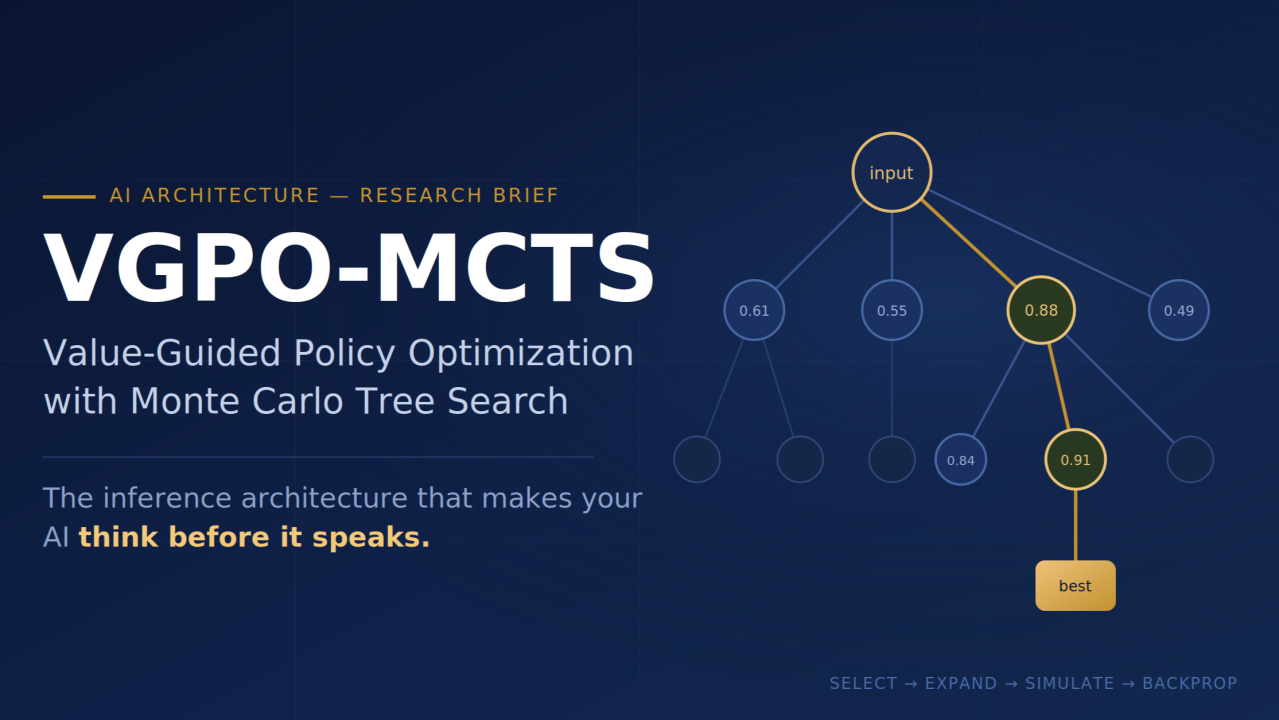
VGPO-MCTS: The Architecture That Makes AI Think Before It Speaks
Why Modern LLMs Are Leaving Performance on the Table
Most enterprise AI deployments today rely on models trained using Reinforcement Learning techniques such as Proximal Policy Optimization (PPO). During training, PPO creates two valuable assets:
- A policy model that generates responses
- A value model that estimates the quality of partially completed reasoning paths
However, in most production environments, only the policy model is used during inference.
The value model—which has learned to evaluate whether a reasoning path is likely to lead to a high-quality outcome—is typically discarded.
This creates a significant inefficiency.
VGPO-MCTS (Value-Guided Policy Optimization with Monte Carlo Tree Search) addresses this gap by bringing the value model back into the inference process, allowing AI systems to evaluate potential reasoning paths before committing to an answer.
The Problem with Greedy Decoding
Traditional language model decoding is fundamentally local.
At every generation step, the model selects the token that appears most probable based on the current context.
While efficient, this approach often causes models to:
- Commit to suboptimal reasoning paths
- Miss better solutions later in the sequence
- Produce logically inconsistent outputs
- Struggle with complex multi-step reasoning tasks
The result is a mismatch between how models are trained and how they are deployed.
During training, the value model evaluates entire trajectories. During inference, those insights are ignored.
VGPO-MCTS attempts to align training-time intelligence with inference-time decision-making.
How VGPO-MCTS Works
The architecture integrates the PPO-trained value model directly into the decoding process using Monte Carlo Tree Search (MCTS), a search framework famously used in AlphaGo.
The process consists of four stages:
Selection
Candidate tokens are evaluated using a combination of policy probability and value estimates.
This allows the model to consider both likelihood and long-term reward before choosing a path.
Expansion
Promising tokens become branches within the search tree, representing alternative reasoning trajectories.
Simulation
The value model estimates the future quality of each branch without requiring full sequence generation.
Backpropagation
Estimated rewards are propagated back through the tree, improving future search decisions.
By repeating this process, the model can effectively “think ahead” before generating an answer.
Why This Matters
VGPO-MCTS transforms decoding from a purely reactive process into a guided search process.
Instead of asking:
"What is the most likely next token?"
The model asks:
"What sequence is most likely to produce the best overall outcome?"
This shift significantly improves reasoning quality.
Empirical Results
Research results demonstrate measurable improvements across multiple text-generation benchmarks.
Reported outcomes include:
- Approximately 5% absolute improvement in preference-based evaluations
- Better performance on helpful and harmless chatbot tasks
- Stronger reasoning consistency
- Improved output quality on complex generation problems
For enterprise deployments, even modest improvements in correctness and reliability can create significant business value.
Beyond Text: Multimodal Reasoning
The value-guided optimization paradigm is not limited to text-based systems.
Recent research extends the concept to multimodal AI through Visually-Guided Policy Optimization (VGPO).
The goal is to solve a common problem in vision-language models known as visual forgetting.
As generated responses become longer, models gradually lose focus on the original image.
VGPO addresses this challenge through:
- Visual Attention Compensation
- Intra-Trajectory Re-weighting
- Inter-Trajectory Re-weighting
These mechanisms help maintain visual grounding throughout the reasoning process.
The Trade-Off: Better Reasoning Comes at a Cost
VGPO-MCTS is not free.
Because the model evaluates multiple candidate branches during generation, it requires:
- Additional compute
- Increased memory usage
- Higher inference latency
For applications requiring instant responses, traditional decoding may still be preferable.
However, for high-stakes domains where correctness matters, the trade-off can be worthwhile.
Examples include:
- Financial analysis
- Legal reasoning
- Clinical decision support
- Software engineering
- Enterprise decision-making
Strategic Implications for Enterprise AI
Several important trends emerge from this research.
Value Models Should Not Be Discarded
Organizations investing in RLHF and PPO training should view value networks as deployable assets rather than temporary training components.
Inference-Time Compute Is Becoming a Competitive Advantage
Modern systems increasingly treat reasoning depth as a configurable parameter.
More compute can be allocated to difficult problems while routine requests remain efficient.
Multi-Model Search Architectures Are Emerging
Research demonstrates that multiple specialized models working together through MCTS can outperform individual frontier models operating independently.
This may become a foundational architecture pattern for enterprise AI systems.
Final Thoughts
The gap between what AI models learn during training and what they use during inference remains one of the most overlooked inefficiencies in modern AI systems.
VGPO-MCTS offers a practical solution by combining value-guided reasoning with search-based inference.
Rather than generating answers token by token with limited foresight, models can evaluate potential reasoning paths and choose higher-quality outcomes.
As enterprises continue deploying AI in mission-critical workflows, architectures that improve reasoning quality without retraining models are likely to become increasingly important.
The future of AI may not depend solely on larger models—but on making better use of the intelligence models already possess.
References:
Liu, J., Cohen, A., Pasunuru, R., Choi, Y., Hajishirzi, H., & Celikyilmaz, A. (2024). Don't Throw Away Your Value Model! Generating More Preferable Text with Value-Guided Monte-Carlo Tree Search Decoding.
Available at:
https://arxiv.org/abs/2309.15028
Additional references include research from Meta FAIR, Sakana AI, OpenAI, DeepSeek-AI, and recent multimodal reasoning studies referenced in the original paper.
Author Note
This article summarizes and interprets recent research on Value-Guided Policy Optimization (VGPO), Monte Carlo Tree Search (MCTS), and inference-time reasoning architectures. All technical findings and benchmark results are attributable to the original authors and cited works. Commentary and analysis reflect the author's perspective.