
Meta-Harness: Why the Code Around Your AI Model Matters More Than the Model Itself
The Most Overlooked Layer in Enterprise AI
When organizations evaluate AI systems, the conversation usually starts with model selection.
Teams compare:
- GPT models
- Claude models
- Gemini models
- Open-source alternatives
The assumption is simple:
Better model = better outcomes.
In practice, however, experienced AI engineers know a different reality.
The model is often not the bottleneck.
What determines success is everything surrounding the model:
- Prompt design
- Retrieval logic
- Context management
- Memory architecture
- Tool orchestration
- Agent workflows
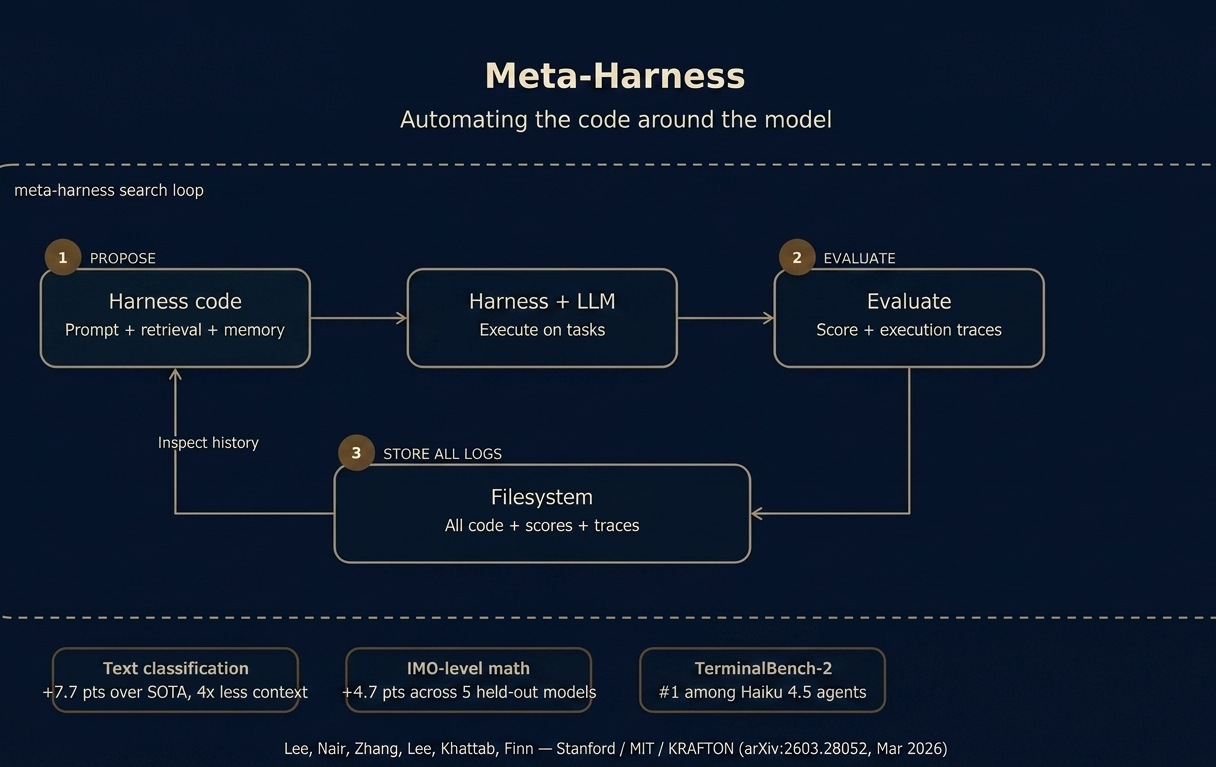
Researchers from Stanford, MIT, and KRAFTON recently published a paper called Meta-Harness, introducing a system that automates optimization of this surrounding infrastructure.
The results suggest that the future of AI performance may depend less on choosing better models and more on optimizing how those models are used.
What Is a Model Harness?
A harness is the operational layer wrapped around a language model.
It determines:
- What information the model receives
- How context is structured
- Which examples are retrieved
- When memory is stored or discarded
- Which tools are called
- How multi-step reasoning is orchestrated
Every production AI application already uses a harness.
The challenge is that most harnesses are still built manually.
Engineers repeatedly:
1. Analyze failures
2. Adjust prompts
3. Modify retrieval logic
4. Tune workflows
5. Run evaluations
This process is often slow, expensive, and highly dependent on individual expertise.
Meta-Harness attempts to automate that process entirely.
The Core Idea Behind Meta-Harness
The framework treats harness engineering as a search and optimization problem.
Instead of relying on human experimentation, Meta-Harness uses a coding agent to:
- Generate harness designs
- Evaluate performance
- Analyze failures
- Refine implementations
- Repeat the process automatically
In the published experiments, the researchers used Claude Code with Claude Opus as the optimization engine.
The coding agent continuously improves the surrounding infrastructure while keeping the underlying model fixed.
This is a significant shift in thinking.
Rather than optimizing model weights, Meta-Harness optimizes the environment in which the model operates.
Why Existing Optimization Methods Fall Short
Several previous approaches have attempted automated prompt optimization.
Examples include:
- OPRO
- TextGrad
- OpenEvolve
- AlphaEvolve-style systems
Most of these methods operate with highly compressed feedback.
The optimizer typically sees:
- Scores
- Summaries
- Small context windows
Meta-Harness takes a different approach.
The system exposes complete historical information including:
- Source code
- Evaluation metrics
- Execution traces
- Previous experiments
- Failure logs
Rather than working with thousands of tokens, Meta-Harness can utilize millions of tokens of diagnostic information.
This dramatically improves its ability to identify patterns and reason about failures.
The Results
The researchers evaluated Meta-Harness across multiple domains.
The outcomes are impressive.
Online Text Classification
Meta-Harness achieved substantially higher accuracy than state-of-the-art manually designed systems while simultaneously reducing context usage.
This demonstrates that smarter orchestration can outperform brute-force scaling.
Retrieval-Augmented Math Reasoning
The system automatically discovered a sophisticated retrieval architecture using specialized retrieval pathways for:
- Algebra
- Geometry
- Number Theory
- Combinatorics
The resulting harness improved performance across multiple language models, including models that were never used during optimization.
This suggests the framework learns transferable design patterns rather than task-specific tricks.
Autonomous Coding Agents
On TerminalBench-style coding evaluations, Meta-Harness produced one of the highest-performing agent configurations.
One particularly interesting discovery involved automatically generating an environment bootstrapping step before execution began.
This seemingly small change produced measurable improvements in agent performance.
The optimization emerged through experimentation rather than human design.
Why Enterprise Leaders Should Pay Attention
Several implications stand out for enterprise AI teams.
1. Harness Design Is a Strategic Asset
Organizations often spend months debating model selection.
This research suggests the larger opportunity may be harness optimization.
A poorly designed harness can significantly reduce the value of even the best frontier model.
2. AI Systems Can Optimize AI Systems
Meta-Harness demonstrates a new pattern:
AI agents improving the environments used by other AI agents.
This introduces a powerful feedback loop.
As coding agents become more capable, they can increasingly optimize the infrastructure that powers future agents.
3. Generalization Matters
One of the strongest findings is that optimized harnesses generalized across:
- Different datasets
- Different tasks
- Different models
This is critical for enterprise deployment because organizations rarely operate a single model in a single environment.
4. Optimization Remains Explainable
Unlike model-weight optimization, harness optimization produces human-readable outputs.
Engineers can inspect:
- Prompt structures
- Retrieval policies
- Workflow logic
- Tool configurations
This makes governance and auditing substantially easier.
The Bigger Trend
Meta-Harness reflects a broader shift occurring across AI engineering.
For years, competitive advantage came primarily from larger models.
Increasingly, value is moving into orchestration layers.
Future enterprise AI platforms may compete based on:
- Context engineering
- Retrieval systems
- Agent coordination
- Memory architectures
- Workflow optimization
rather than model size alone.
The model becomes a component of a larger intelligent system.
What This Means for CTOs and AI Leaders
If you're building AI systems in production today, several practical lessons emerge:
Invest Beyond Model Selection
Model evaluations should be accompanied by evaluation of:
- Prompt architectures
- Retrieval systems
- Agent workflows
- Tool integrations
Treat Harnesses as Intellectual Property
The orchestration layer increasingly represents a significant source of competitive advantage.
Explore Automated Optimization
Manual prompt tuning and workflow refinement may soon become insufficient for large-scale deployments.
Organizations should begin evaluating automated optimization approaches.
Final Thoughts
Meta-Harness reinforces a lesson that experienced AI builders have quietly understood for years:
The quality of an AI system is often determined less by the model itself and more by the environment surrounding it.
The research demonstrates that significant performance gains can be achieved without changing model weights.
Instead, improvements emerge from better:
- Context management
- Retrieval strategies
- Workflow orchestration
- Memory systems
As enterprise AI matures, automated harness optimization may become as important as model training itself.
The future of AI performance may not be about building larger models.
It may be about building smarter systems around them.
References
Lee, Y., Nair, R., Zhang, Q., Lee, K., Khattab, O., & Finn, C. (2026). Meta-Harness: End-to-End Optimization of Model Harnesses. arXiv:2603.28052.
Project Page:
https://yoonholee.com/meta-harness/
GitHub Repository:
https://github.com/stanford-iris-lab/meta-harness-tbench2-artifact
Author Note
This article provides an independent analysis of Meta-Harness and its implications for enterprise AI architecture. All benchmark results, experimental findings, and technical descriptions are derived from the original research paper. Commentary and interpretation reflect the author's perspective.