
When Context Windows Are Not Enough: Hypergraph-Enhanced LLMs for Long-Sequence EDR Log Analysis
Why Traditional Threat Detection Struggles at Scale
Endpoint Detection and Response (EDR) systems generate enormous volumes of telemetry every day.
Modern enterprises collect millions of security events from:
- Process executions
- File system activity
- Registry modifications
- Network connections
- User behavior
While this data is invaluable for detecting cyber threats, it introduces a significant challenge.
The signal is buried inside the noise.
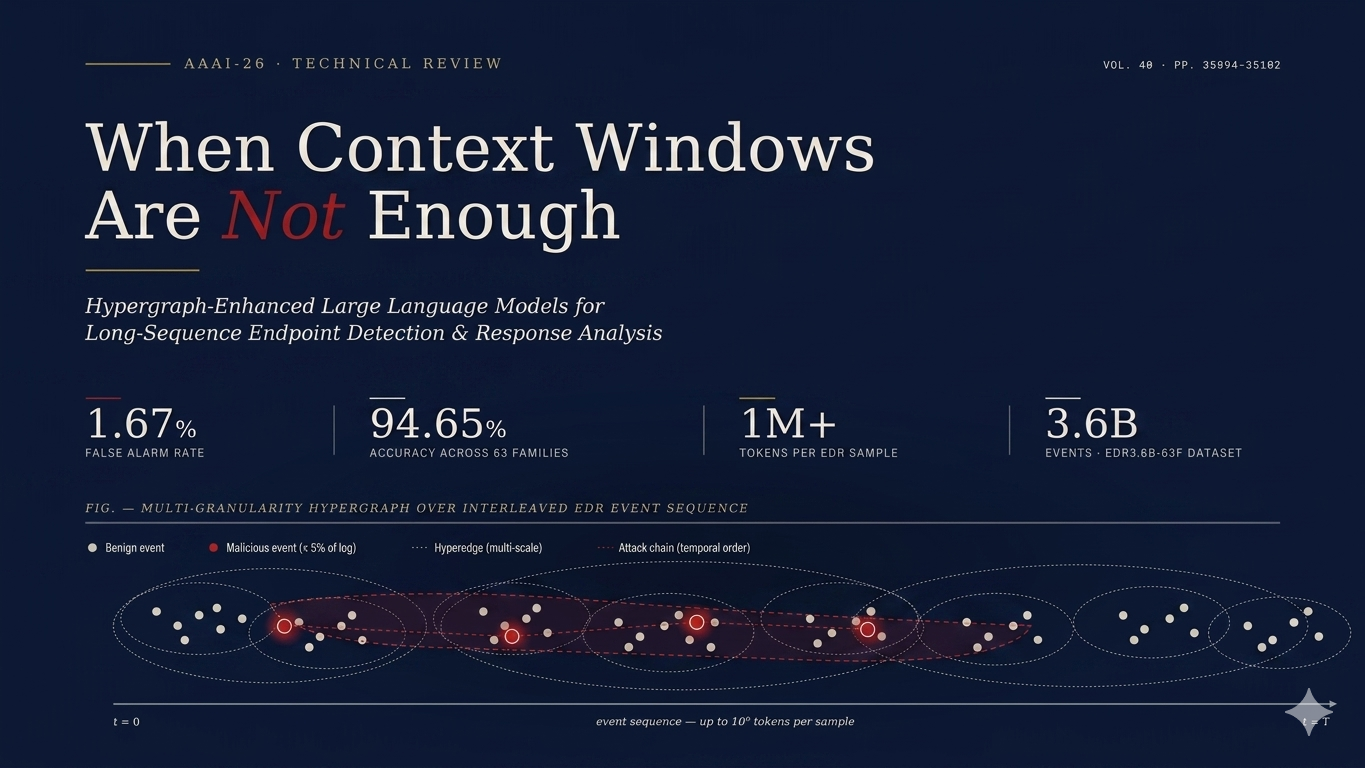
Malicious activities often represent less than 5% of total event volume and are frequently distributed across massive log sequences that can exceed one million tokens after tokenization.
Traditional security tools struggle to process this scale efficiently.
Even large language models face limitations when dealing with extremely long contexts and sparse threat signals.
A recent AAAI-26 paper introduces HyperGLLM, a framework that combines Hypergraph Neural Networks with Large Language Models to address this challenge.
The approach offers an important insight:
The future of cybersecurity may not depend on larger context windows alone, but on smarter structural representations of security data.
The Core Challenge of EDR Log Analysis
The researchers identify three major problems that define modern endpoint security analytics.
1. Extreme Context Length
More than 80% of EDR samples in the study exceed one million tokens.
This is far beyond the context windows of most production LLMs.
Even advanced context-extension techniques struggle at this scale.
2. Sparse Threat Signals
Threat events typically account for less than 5% of all recorded activity.
Finding these events resembles locating a handful of suspicious transactions within an ocean of legitimate behavior.
3. Semantic Camouflage
Individual malicious events often appear identical to benign events.
The threat is rarely visible in a single action.
Instead, malicious intent emerges from relationships between multiple events distributed throughout the sequence.
This makes traditional sequence-based detection particularly difficult.
Introducing HyperGLLM
HyperGLLM addresses these challenges through a three-layer architecture that combines structural learning with language-model reasoning.
Instead of feeding raw logs directly into an LLM, the framework first transforms security events into graph-based representations.
The result is a more efficient and semantically meaningful view of endpoint activity.
Layer 1: Attribute-Value Relation Graphs
The first stage converts each event into a graph structure.
Rather than treating an event as plain text, the model represents:
- Process names
- Command lines
- File paths
- Action types
- Network metadata
as interconnected attribute-value nodes.
This enables the model to preserve structural relationships that would otherwise be lost in standard tokenization.
The graph acts as an intelligent compression mechanism, reducing redundancy while retaining critical behavioral information.
Layer 2: Differential Hypergraph Modeling
The second stage introduces a hypergraph network.
Unlike traditional graphs that connect pairs of nodes, hypergraphs can connect multiple related events simultaneously.
This makes them particularly well-suited for representing attack chains involving:
- Processes
- Files
- Registry keys
- Network interactions
across extended periods of time.
Multi-Granularity Clustering
HyperGLLM creates hyperedges at multiple scales.
This allows the model to capture:
- Fine-grained local behaviors
- High-level attack patterns
- Long-range behavioral dependencies
simultaneously.
Differential Learning Mechanism
A second hypergraph is created to model global benign behavior.
The model then subtracts benign patterns from observed activity.
This effectively suppresses normal operational noise and amplifies anomalous behavior.
The result is improved detection of subtle threats hidden within large volumes of legitimate activity.
Layer 3: LLM Alignment and Reasoning
Once the hypergraph representations are generated, they are projected into the embedding space of a Large Language Model.
The researchers use Qwen2.5-3B-Instruct as the reasoning backbone.
A two-stage training process is employed:
Stage One
The language model remains frozen while graph representations are aligned.
Stage Two
The entire system is fine-tuned jointly.
This approach helps preserve both cybersecurity-specific knowledge and the reasoning capabilities of the LLM.
The EDR3.6B-63F Dataset
An important contribution of the research is the creation of EDR3.6B-63F.
The dataset contains:
- Approximately 3.6 billion EDR events
- More than 2 million labeled samples
- 62 malicious behavior families
- Large-scale benign activity records
This makes it one of the most comprehensive datasets currently available for endpoint security research.
The dataset itself represents a significant contribution to the cybersecurity community.
Performance Results
The reported results demonstrate substantial improvements over traditional approaches.
Better Detection Accuracy
HyperGLLM consistently outperforms:
- Standard LLM baselines
- LongRoPE context-extension approaches
- ScamNet-style architectures
across multiple evaluation metrics.
Reduced False Positives
One of the most valuable outcomes is the reduction in false alarm rates.
Lower false-positive rates directly improve analyst productivity and reduce alert fatigue.
Improved Computational Efficiency
At million-token scale, HyperGLLM requires:
- Less than one-fifteenth of the GPU memory used by baseline approaches
- Less than one-thousandth of the Time-to-First-Token compared to some alternatives
These efficiency gains are critical for real-world deployment.
Why Context Window Expansion Alone Is Not Enough
One of the most important findings from the paper is that larger context windows alone do not solve the problem.
Techniques such as:
- LongRoPE
- YaRN
- SelfExtend
help process longer sequences.
However, they do not address:
- Threat sparsity
- Semantic camouflage
- Structural relationships between events
HyperGLLM suggests that structural understanding may be more important than raw context length.
Broader Implications
The architectural principles behind HyperGLLM extend beyond endpoint security.
Similar approaches could benefit:
- Network traffic analysis
- Security event correlation
- Industrial control system monitoring
- Supply-chain attack investigation
- Digital forensics
- Compliance monitoring
Any domain characterized by:
- Massive event streams
- Sparse anomalies
- Complex relationships
could potentially benefit from graph-enhanced reasoning architectures.
Open Research Questions
Despite promising results, several important challenges remain.
Adversarial Robustness
Can attackers manipulate hypergraph structures to evade detection?
Cross-Platform Generalization
Will the model perform equally well across different EDR products and telemetry schemas?
Explainability
How can analysts understand which hypergraph relationships triggered a detection?
Real-Time Deployment
Can hypergraph construction operate efficiently on streaming telemetry at enterprise scale?
These questions will likely shape future research directions.
Final Thoughts
HyperGLLM addresses a fundamental challenge in modern cybersecurity:
How do we detect meaningful threats hidden inside millions of benign events?
Rather than relying solely on larger language models or expanded context windows, the framework introduces a structural layer that captures relationships before reasoning occurs.
The results suggest a broader architectural lesson.
For many enterprise AI applications, success may depend less on increasing context length and more on creating intelligent intermediate representations that help models focus on what truly matters.
As cybersecurity telemetry continues to grow, graph-enhanced reasoning architectures like HyperGLLM may become a foundational component of next-generation threat detection systems.
References
Zhou, H., Pan, J., Peng, M., Huang, S., & Zheng, H. (2026). HyperGLLM: An Efficient Framework for Endpoint Threat Detection via Hypergraph-Enhanced Large Language Models. Proceedings of the Fortieth AAAI Conference on Artificial Intelligence (AAAI-26), pp. 35094–35102.
Additional references include research on LongRoPE, YaRN, SelfExtend, Graph Attention Networks, Qwen2.5, DeepSeek-R1, ATLAS, and other cited works referenced in the original paper.
Author Note
This article provides an independent technical analysis of HyperGLLM and its implications for endpoint security research. All architectural descriptions, benchmark results, and dataset statistics are derived from the cited research paper. Analysis and interpretation reflect the author's perspective.