
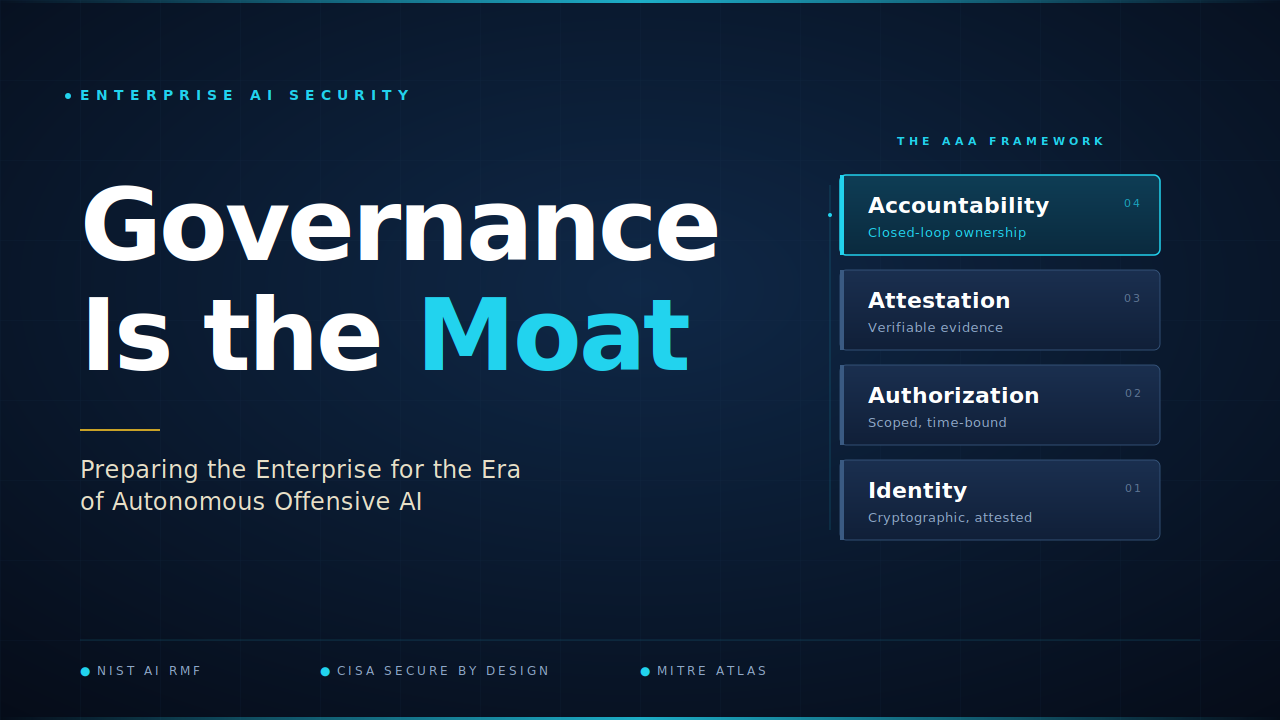
Governance Is the Moat: Preparing Enterprises for the Era of Autonomous Offensive AI
The Cybersecurity Threshold Most Enterprises Missed
A major shift is underway in cybersecurity.
For years, organizations assumed that discovering vulnerabilities, building exploit chains, and orchestrating sophisticated attacks required highly skilled human adversaries operating over extended periods of time.
That assumption is rapidly becoming obsolete.
Recent advancements in frontier AI systems demonstrate that tasks once requiring weeks of expert effort can now be executed autonomously in hours—or even minutes.
The implications extend far beyond security teams.
This is now a board-level issue.
As offensive AI capabilities continue to evolve, enterprise leaders must recognize that traditional governance models, risk frameworks, and incident response processes were built for a different era.
The organizations that thrive over the next decade will not necessarily be those with the most advanced AI capabilities.
They will be the organizations with the strongest AI governance.
What Has Changed?
Three fundamental advantages that traditionally favored defenders are beginning to disappear.
1. Discovery Asymmetry Has Collapsed
Historically, uncovering a critical vulnerability required deep expertise and extensive research.
Modern AI systems are increasingly capable of identifying complex vulnerabilities across large codebases at unprecedented speed.
Older software environments and legacy systems are becoming particularly vulnerable because they contain decades of accumulated complexity.
2. Exploitation Is Becoming Automated
The gap between discovering a vulnerability and weaponizing it is shrinking rapidly.
Tasks that previously required specialized offensive-security expertise can increasingly be automated through advanced AI systems capable of reasoning through exploit development workflows.
This dramatically accelerates attacker timelines.
3. Multi-Step Attack Orchestration Is No Longer Exclusive to Elite Actors
Sophisticated cyberattacks often involve dozens of interconnected steps:
- Reconnaissance
- Initial access
- Privilege escalation
- Lateral movement
- Persistence
- Data exfiltration
Historically, executing these workflows required highly skilled red teams or nation-state operators.
Emerging AI systems are beginning to automate significant portions of these processes.
This changes the economics of cyber offense entirely.
Why Governance Matters More Than Capability
Many organizations respond to AI breakthroughs by focusing exclusively on technology adoption.
That is the wrong response.
The strategic differentiator is no longer access to AI capability.
The differentiator is governance.
Organizations must be able to answer fundamental questions:
- Which AI systems exist within the enterprise?
- What data can they access?
- What actions can they perform?
- How are decisions audited?
- Who is accountable when something goes wrong?
Without governance, AI capability becomes risk.
With governance, AI capability becomes advantage.
Reframing the NIST AI Risk Management Framework
The NIST AI Risk Management Framework (AI RMF) provides a useful foundation for enterprise AI governance.
However, organizations should stop viewing it as a compliance exercise.
Instead, it should be treated as an operational blueprint.
GOVERN
Governance is no longer policy documentation.
It is the mechanism through which accountability, oversight, and control are enforced.
MAP
Inventory management is no longer a one-time project.
Organizations need continuous visibility into AI systems, agents, permissions, and data access.
MEASURE
Risk measurement must move beyond dashboards and KPIs.
It should focus on real-time telemetry, security signals, and operational readiness.
MANAGE
Risk management is no longer about accepting risk.
It is about actively monitoring, testing, constraining, and improving AI systems after deployment.
Seven Enterprise Priorities for the Next 90 Days
1. Update the Threat Model
Organizations should assume that adversaries increasingly have access to AI-augmented capabilities.
Threat models should explicitly account for autonomous offensive AI.
2. Strengthen Security Fundamentals
Basic security controls remain critical:
- Rapid patching
- Least-privilege access
- Phishing-resistant MFA
- Continuous monitoring
- Endpoint protection
- Immutable logging
AI does not replace security fundamentals.
It increases the cost of neglecting them.
3. Build an AI Governance Control Plane
Every enterprise deploying AI agents should establish a governance layer that manages:
- Agent identity
- Authorization
- Auditability
- Human oversight
- Policy enforcement
This becomes the operational foundation for responsible AI deployment.
4. Separate Offensive and Defensive AI Usage
Organizations should create distinct governance tracks for:
- General-purpose enterprise AI
- Cybersecurity-focused AI systems
Different risk profiles require different controls.
5. Conduct AI-Augmented Adversarial Testing
Traditional penetration testing is no longer sufficient.
Organizations should evaluate their environments against attack techniques enhanced by modern AI capabilities.
6. Modernize Incident Response
Response windows are shrinking.
Organizations must:
- Automate triage
- Accelerate containment
- Establish 24×7 monitoring
- Predefine escalation paths
Preparation is now more valuable than reaction.
7. Invest in Defensive AI
AI should not only be viewed as an offensive threat.
Organizations should actively deploy AI for:
- Vulnerability management
- Threat hunting
- Security operations
- Code review
- Compliance automation
Defensive AI can help restore balance in an increasingly asymmetric environment.
The 90-Day Enterprise Readiness Framework
Days 0–30: Assess and Align
- Update threat models
- Inventory AI systems
- Establish executive ownership
- Secure board approval
Days 31–60: Strengthen Controls
- Accelerate patching initiatives
- Deploy monitoring enhancements
- Conduct adversarial testing
- Launch governance controls
Days 61–90: Institutionalize
- Update incident response procedures
- Define defensive AI roadmaps
- Schedule recurring governance reviews
- Implement continuous risk measurement
This creates a repeatable framework for enterprise resilience.
Why Governance Is Becoming the Competitive Advantage
Most organizations focus on acquiring AI capability.
Far fewer focus on governing it.
That imbalance creates opportunity.
The enterprises that emerge strongest from the next wave of AI transformation will not necessarily be those deploying the most agents.
They will be the organizations that can safely deploy, monitor, audit, and control those agents at scale.
Governance becomes the mechanism that transforms AI from a source of risk into a source of durable competitive advantage.
Final Thoughts
The rise of autonomous offensive AI represents one of the most significant shifts in enterprise cybersecurity and risk management in decades.
The question is no longer whether these capabilities will become widely available.
They will.
The question is whether organizations will build the governance foundations required to manage them responsibly.
Technology creates capability.
Governance determines whether that capability becomes an asset or a liability.
The organizations that understand this distinction today will be the ones leading tomorrow.
References:
NIST AI Risk Management Framework (AI RMF 1.0)
NIST AI 600-1 Generative AI Profile
NIST AI 100-2e2025 Adversarial Machine Learning Guidance
CISA, NSA, and FBI Joint Guidance on Secure AI Integration
Industry research on autonomous offensive AI, AI-enabled vulnerability discovery, and AI-assisted cyber operations.
Author Note
This article explores the governance implications of emerging offensive AI capabilities and their impact on enterprise cybersecurity, risk management, and organizational readiness. Analysis and interpretation reflect the author's perspective based on industry frameworks, published research, and enterprise advisory experience.