
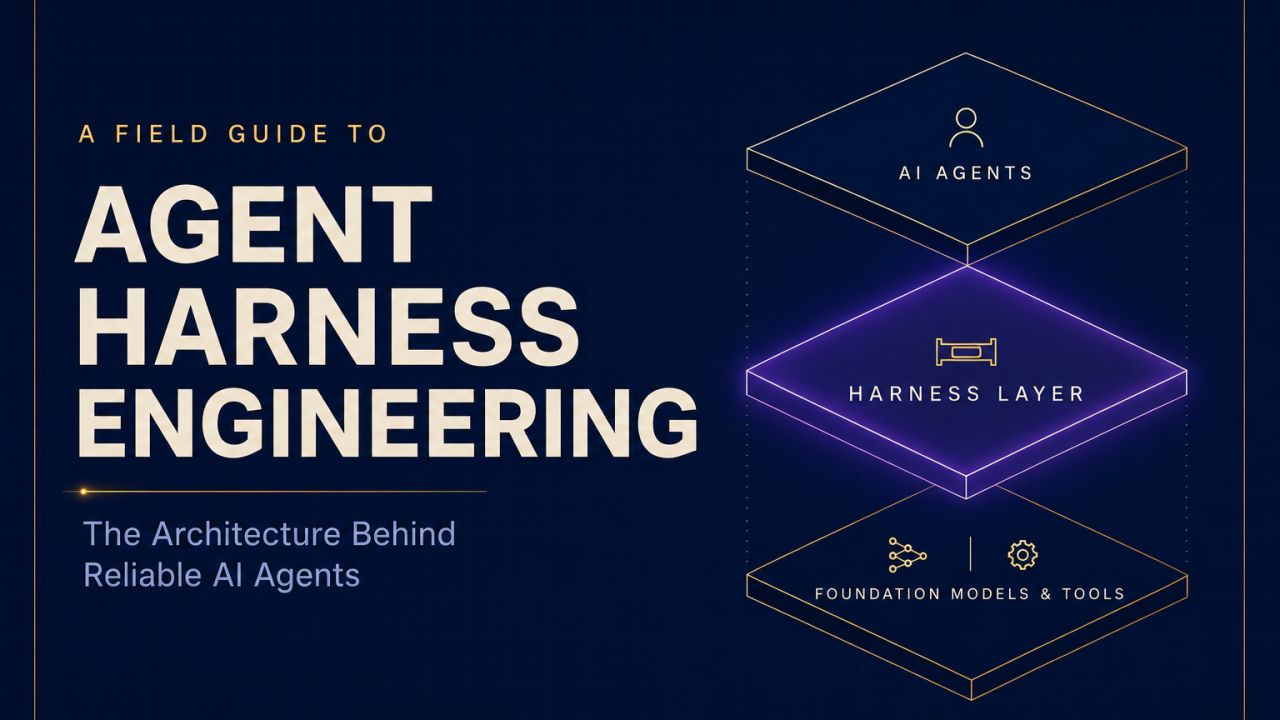
A Field Guide to Agent Harness Engineering: The Architecture Behind Reliable AI Agents
The Industry Is Optimizing the Wrong Thing
For the past several years, enterprise AI strategy has largely revolved around a single question:
Which model should we use?
Organizations compared:
- GPT models
- Claude models
- Gemini models
- DeepSeek models
- Open-source alternatives
The prevailing assumption was straightforward:
A better model produces a better agent.
However, a growing body of research published throughout 2026 challenges that assumption.
Across multiple studies, researchers are reaching a remarkably consistent conclusion:
The primary determinant of real-world agent reliability is no longer the model itself.
It is the system surrounding the model.
That system is increasingly referred to as the Agent Harness.
And for enterprise AI leaders, understanding harness engineering may become more important than understanding prompt engineering.
What Is an Agent Harness?
An agent harness is the runtime layer that governs how an AI agent:
- Observes information
- Makes decisions
- Uses tools
- Stores memory
- Recovers from errors
- Verifies outcomes
- Interacts with external systems
Think of the model as an engine.
The harness is everything else:
- The steering system
- The transmission
- The brakes
- The dashboard
- The safety systems
Most organizations focus almost exclusively on the engine.
The latest research suggests that reliability, cost, governance, and scalability are increasingly determined by the rest of the vehicle.
Why the Harness Matters
Researchers describe this shift as the externalization of intelligence.
Rather than embedding every capability inside model weights, modern AI systems increasingly rely on external systems for:
Memory
Maintaining context across long-running workflows.
Skills
Specialized tools and capabilities.
Protocols
Standardized ways of interacting with services and other agents.
Runtime Governance
Rules that determine how decisions are executed and verified.
The harness becomes the orchestration layer that coordinates all of these components.
The result is an important shift in thinking:
Capability no longer lives exclusively inside the model.
It lives inside the runtime.
The Six Components of a Modern Agent Harness
One of the most influential frameworks emerging from recent research defines an agent harness as six core components.
1. Execution Loop (E)
Controls the observe-think-act cycle.
Responsible for:
- Task sequencing
- Termination logic
- Error recovery
- Workflow progression
Without a robust execution loop, agents can become trapped in endless reasoning cycles.
2. Tool Registry (T)
Provides access to external tools and services.
This includes:
- APIs
- Databases
- Search systems
- Internal enterprise platforms
Tool governance increasingly determines what an agent can accomplish.
3. Context Manager (C)
Controls what information enters the model's context window.
This includes:
- Retrieval
- Prioritization
- Summarization
- Context compression
Poor context management is often the hidden cause of escalating AI costs.
4. State Store (S)
Maintains durable memory across sessions.
Without state persistence, long-running workflows become fragile and unreliable.
5. Lifecycle Controls (L)
Responsible for:
- Authentication
- Logging
- Policy enforcement
- Monitoring
- Auditability
This layer becomes critical in enterprise environments.
6. Verification Layer (V)
Measures outcomes and validates behavior.
Verification is one of the most underdeveloped capabilities across today's AI ecosystem despite being one of the most important.
Why Reliability Is Becoming a Harness Problem
Several studies published during 2026 reveal a surprising pattern.
Significant performance improvements can often be achieved without changing the underlying model.
Examples include:
- Improved tool orchestration
- Better context injection
- Enhanced verification workflows
- More effective memory systems
In some cases, harness improvements have produced gains comparable to or greater than upgrading to a more advanced model.
This finding has profound implications for enterprise AI investment strategies.
The bottleneck is increasingly not intelligence.
It is orchestration.
The Three Eras of AI Engineering
The evolution of AI systems can be understood through three distinct phases.
Era One: Prompt Engineering
The focus was simple:
"How do we write better prompts?"
Organizations optimized instructions, examples, and prompt templates.
Era Two: Context Engineering
The focus shifted toward:
"What information should the model see?"
Memory systems, retrieval pipelines, and context management became priorities.
Era Three: Harness Engineering
The current frontier asks a larger question:
"What runtime architecture produces reliable outcomes?"
This includes:
- Governance
- Observability
- Verification
- Recovery
- Security
- Lifecycle management
Most enterprises still operate in Era One or Two while attempting to solve Era Three problems.
Code vs Natural Language: Two Competing Approaches
Researchers are currently exploring two major ways to define harness behavior.
Code-Based Harnesses
Harness logic is implemented directly in software.
Advantages:
- Executable
- Verifiable
- Testable
- Reliable
Ideal for production systems.
Natural-Language Harnesses
Harness behavior is described through structured policies and instructions.
Advantages:
- Human-readable
- Easier to audit
- Easier to modify
- Accessible to non-engineers
The most mature systems increasingly combine both approaches.
Natural language defines policy.
Code enforces policy.
The Next Frontier: Self-Improving Harnesses
Perhaps the most important trend is that harnesses themselves are becoming adaptive.
Emerging frameworks can:
- Analyze failures
- Identify weaknesses
- Modify workflows
- Improve execution strategies
- Optimize themselves over time
This represents a major shift.
Organizations are no longer simply training models.
They are creating systems capable of improving their own operating environments.
The competitive advantage increasingly belongs to organizations whose harnesses evolve fastest.
Why This Matters for Enterprise AI Leaders
Several practical implications emerge.
Stop Evaluating Models in Isolation
The same model can produce dramatically different outcomes depending on the harness surrounding it.
Vendor evaluations should include harness architecture reviews.
Invest in Runtime Engineering
Many organizations allocate most of their AI budget toward models and fine-tuning.
The evidence increasingly suggests that harness engineering may deliver higher returns.
Measure Cost Per Task
Token usage alone is no longer sufficient.
The true economic metric is:
Cost Per Completed Task
And that metric is heavily influenced by harness design.
Treat Security as a Harness Responsibility
Many AI risks originate from:
- Tool misuse
- State corruption
- Permission errors
- Workflow failures
These are often runtime problems rather than model problems.
Build Observability First
Organizations cannot improve what they cannot observe.
Logging, evaluation, and verification infrastructure should be treated as foundational capabilities.
The Bigger Picture
The AI industry spent years optimizing models.
The next phase of innovation is increasingly focused on systems.
This mirrors previous shifts in computing.
The most successful platforms were rarely defined by a single component.
They succeeded because the surrounding infrastructure enabled reliable execution at scale.
Agent harnesses appear to be becoming that infrastructure layer for AI.
Final Thoughts
2025 may have been remembered as the year of AI agents.
2026 is increasingly becoming the year of agent harnesses.
The emerging research makes one thing clear:
The future of enterprise AI will not be determined solely by model intelligence.
It will be determined by how effectively organizations manage:
- Memory
- Tools
- State
- Verification
- Governance
- Runtime execution
The model remains important.
But models alone do not create reliable systems.
The organizations that build the strongest harnesses will ultimately build the most capable agents.
In the coming years, competitive advantage may belong not to those with the smartest model—but to those with the smartest runtime architecture.
References
Ning, X., Tieu, K., Fu, D., Wei, T., et al. (2026). *Code as Agent Harness.*
Pan, L., Zou, L., Guo, S., Ni, J., & Zheng, H. (2026). *Natural-Language Agent Harnesses.*
He, C., Zhou, X., Wang, D., Xu, H., Liu, W., & Miao, C. (2026). *Harness Engineering for Language Agents: The Harness Layer as Control, Agency, and Runtime.*
Meng, Q., Wang, Y., Chen, L., et al. (2026). *Agent Harness for Large Language Model Agents: A Survey.*
Zhou, C., Chai, H., Chen, W., et al. (2026). *Externalization in LLM Agents.*
Chen, M., Lv, C., Zhang, G., et al. (2026). HarnessForge: Joint Harness and Policy Evolution for Adaptive Agent Systems.
Huang, H., Shi, J., Li, Y., & Chen, Y. (2026). *Affordance Agent Harness: Verification-Gated Skill Orchestration.*
Author Note
This article synthesizes recent research on Agent Harness Engineering and explores its implications for enterprise AI systems. All architectural concepts, frameworks, and research findings are derived from the referenced academic papers and surveys. Interpretation and analysis reflect the author's perspective.