
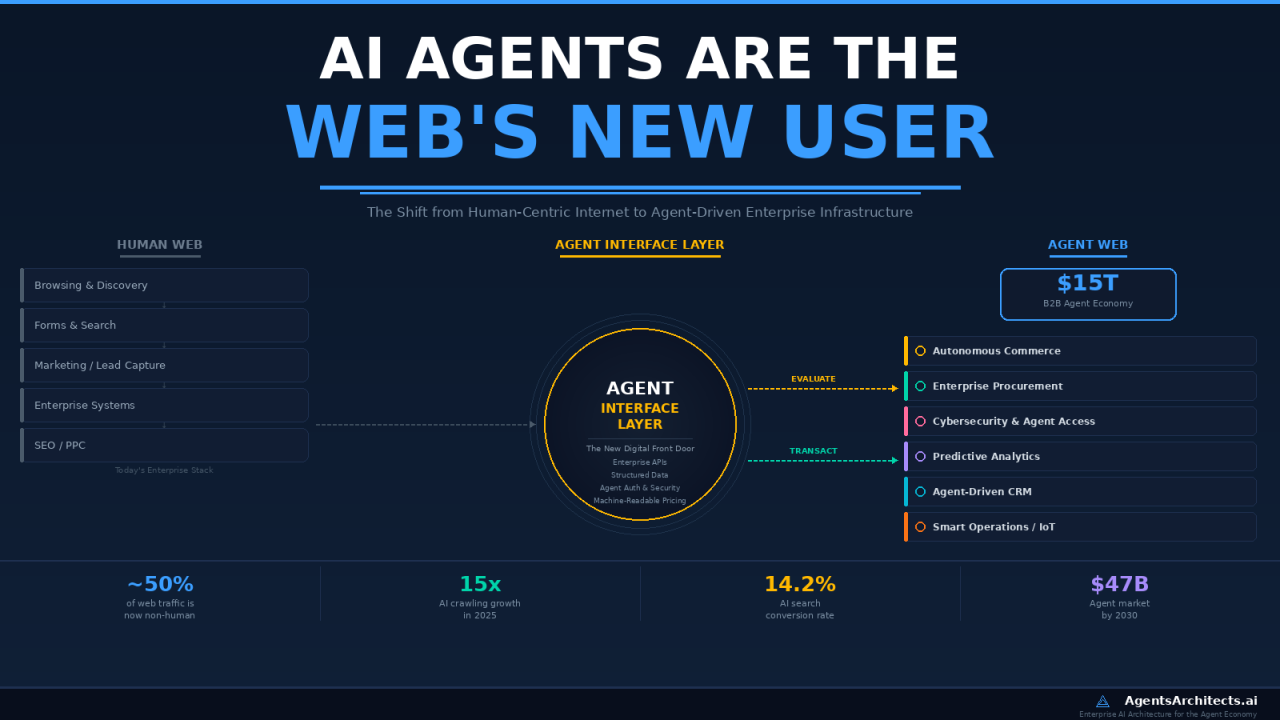
AI Agents Are the Web's New User
Why Your Enterprise Digital Infrastructure Isn't Ready for Them
For more than two decades, the internet has been designed around a simple assumption:
A human sits behind a screen.
Every aspect of modern digital infrastructure from websites and search engines to e-commerce experiences and enterprise portals was built for human attention, human navigation, and human decision-making.
That assumption is rapidly changing.
A new type of user is arriving at every enterprise's digital front door:
AI agents.
Unlike human users, AI agents operate continuously, process information at machine speed, evaluate alternatives instantly, and increasingly make decisions on behalf of both consumers and enterprises.
This is not simply another wave of automation.
It represents one of the most significant shifts in digital architecture since the emergence of the web browser itself.
Organizations that fail to prepare for agent-mediated interactions risk becoming invisible to the next generation of buyers, customers, and business partners.
The Internet's Fastest-Growing User Segment
Evidence of this shift is already visible.
Across the web, non-human traffic is growing at an unprecedented pace.
AI systems are increasingly:
- Discovering products
- Evaluating vendors
- Comparing services
- Reading documentation
- Conducting research
- Initiating transactions
without direct human involvement.
What makes this transition unique is that these systems are not merely crawling content.
They are acting on behalf of users.
An AI agent may soon become the first evaluator of your products, pricing, APIs, compliance posture, and technical capabilities long before a human decision-maker becomes involved.
For many organizations, the first buyer interaction of the future will not be human.
It will be agentic.
Why This Matters More Than Traditional Search
For years, digital strategy focused on visibility through:
- Search Engine Optimization (SEO)
- Paid advertising
- Content marketing
- Conversion funnels
These mechanisms assumed humans would perform the evaluation process.
Agentic systems fundamentally change this model.
Instead of searching, clicking, comparing, and evaluating manually, users increasingly delegate those tasks to intelligent agents.
The result is a new optimization challenge:
Not how to rank on search engines.
But how to be selected by AI agents.
This emerging discipline is increasingly referred to as:
Agent Engine Optimization (AEO)
And it may become as important over the next decade as SEO was over the last two.
What AI Agents Actually Do
Many executives still think of AI agents as advanced chatbots.
That view dramatically understates their capabilities.
Modern AI agents can:
- Browse websites
- Access APIs
- Retrieve information
- Compare alternatives
- Execute workflows
- Make recommendations
- Initiate transactions
with minimal human intervention.
Several enterprise use cases are already emerging.
Procurement and Vendor Selection
Agents can analyze:
- Pricing structures
- Product capabilities
- API documentation
- Compliance certifications
- Technical requirements
before procurement teams become involved.
If critical information is hidden behind forms, PDFs, or fragmented websites, the agent may simply move on.
Customer Service and Operations
AI agents increasingly resolve support requests through direct interaction with enterprise systems.
Rather than reading FAQ pages, they consume structured data and orchestrate workflows automatically.
Financial Research and Due Diligence
Investment teams and corporate strategy groups are deploying agents to:
- Analyze filings
- Compare companies
- Review disclosures
- Surface risks
at a scale impossible for human analysts alone.
Commerce and Purchasing
Consumers are beginning to delegate purchasing decisions to AI systems.
As conversational commerce matures, traditional e-commerce journeys may increasingly be bypassed entirely.
Software Evaluation
Technology buyers can now deploy agents to evaluate:
- Developer documentation
- API quality
- Platform reliability
- Product capabilities
before engaging with sales teams.
This transforms technical content into a primary revenue driver.
Five Hard Truths for Enterprise Leaders
1. Your Website Was Built for Humans
Most enterprise digital experiences rely heavily on:
- Visual design
- Interactive elements
- Dynamic rendering
- Marketing narratives
AI agents care about none of these things.
They require:
- Structured data
- Machine-readable content
- Accessible APIs
- Clear specifications
The future belongs to organizations that build digital experiences for both humans and machines.
2. Traditional Content Strategies Are Becoming Obsolete
AI systems increasingly generate answers directly.
The goal is no longer simply appearing in search results.
The goal is becoming a trusted source cited by intelligent systems.
This requires content architectures optimized for machine consumption.
3. Sales Funnels Assume Human Buyers
Traditional funnels depend on:
- Testimonials
- Social proof
- Visual persuasion
- Marketing psychology
Agents evaluate:
- Technical capabilities
- Documentation quality
- Performance metrics
- Pricing transparency
This requires a fundamental redesign of digital go-to-market strategies.
4. Data Architecture Is Becoming a Competitive Advantage
Agentic systems thrive in environments with:
- Clean APIs
- Structured data
- Consistent schemas
- Reliable documentation
Organizations with fragmented infrastructure will struggle to participate effectively in agent-driven ecosystems.
5. The Timeline Is Short
The transition is already underway.
Organizations that delay adaptation may discover that competitors have already become the preferred choice for agent-mediated procurement and commerce.
The Enterprise Playbook
Build an Agent Interface Layer
Create machine-readable access points that expose:
- Product information
- Pricing
- Technical documentation
- Compliance data
- Availability
Think of this as a storefront designed specifically for AI agents.
Invest in Agent Engine Optimization
Just as SEO became a strategic necessity, organizations should begin optimizing for:
- AI discoverability
- Structured content
- Knowledge accessibility
- Agent consumption
Design for Dual Audiences
Every digital asset should serve:
- Human users
- AI agents
with equal effectiveness.
The future web requires both.
Measure Agent Traffic
Most organizations track human behavior extensively.
Very few understand:
- Which agents visit
- What information they consume
- Which resources influence decisions
This visibility will become increasingly important.
Improve Pricing Transparency
Opaque pricing creates friction for agents.
Machine-evaluable value propositions will increasingly outperform traditional "contact sales" approaches.
Secure the Agent Perimeter
Agent authentication, authorization, auditing, and behavioral monitoring will become foundational enterprise capabilities.
Organizations should begin building these controls today.
Appoint an Agent Experience Owner
Someone inside the organization should own:
- Agent discoverability
- Agent usability
- Agent security
- Agent commerce readiness
The companies that treat this as a strategic function will move faster than those that treat it as an IT project.
Why This Is Bigger Than SEO
Many leaders view agent optimization as an extension of search optimization.
It is much larger than that.
SEO helped users find information.
Agent readiness determines whether autonomous systems can:
- Evaluate your organization
- Trust your organization
- Integrate with your organization
- Buy from your organization
The shift affects marketing, sales, engineering, product, security, and corporate strategy simultaneously.
Final Thoughts
The internet is experiencing its most significant user transition since the rise of mobile computing.
For decades, digital infrastructure was designed for human interaction.
The next decade will require infrastructure designed equally for autonomous software agents.
The organizations that thrive will not simply have better AI.
They will have digital ecosystems that AI can discover, understand, evaluate, and transact with effortlessly.
The web's most important new user does not browse.
It does not click.
It does not fill out forms.
It arrives with an objective, an API call, and the authority to act.
The question for enterprise leaders is simple:
When that agent arrives at your digital front door, will it know how to work with your business?
References:
Cloudflare Radar Report (2025)
Gartner Strategic Predictions (2026)
McKinsey Digital Research on AI and Agentic Commerce
Industry research on AI agents, enterprise procurement automation, and Agent Engine Optimization (AEO).
Author Note
This article explores the rise of AI agents as a new class of digital users and examines the implications for enterprise architecture, digital strategy, commerce, and customer engagement. Analysis and interpretation reflect the author's perspective based on industry research and enterprise AI implementation experience.